Below you will find a graphic that provides a visual explanation as to how the Emotometrics’ process works.
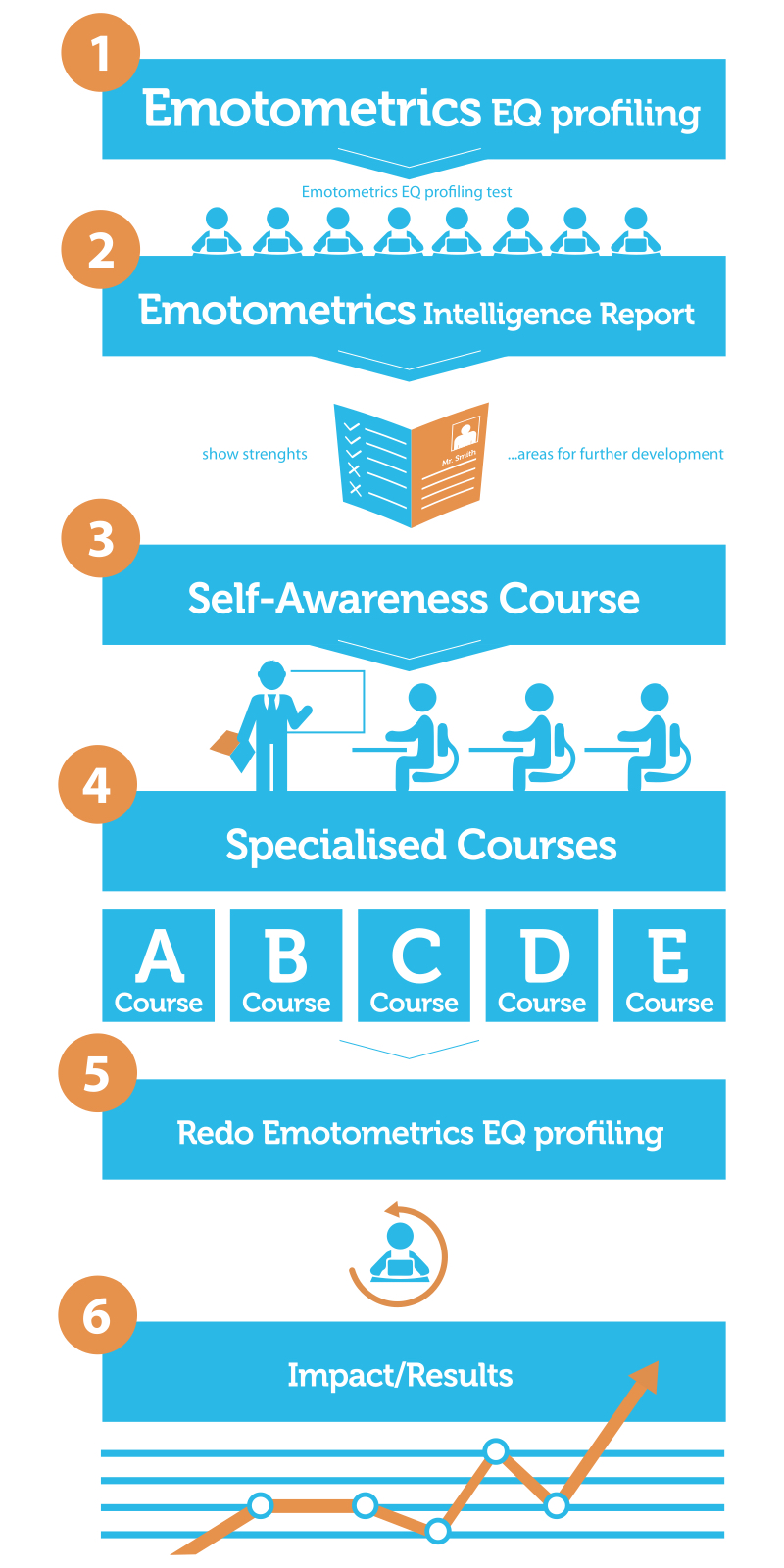
1. EQ Profiling
After a profile has been created for the employee, the employee logs in to complete the comprehensive questionnaire which comprises 150 questions and takes about 40 minutes to finish.
2. Automatic EQ Report Generation
Upon completion an emotional intelligence report is automatically generated by the system. The report, comprising seven pages, reveals the strengths and areas for improvement of the employee’s intra- and inter personal competencies. Pinpointing the training needs of the employee, the report assists the HR in setting up a Personal Development Programme to help the employee reach his full potential.
This EQ profiling tool can also be used by recruiters to quickly ascertain from a candidate shortlist which person is the best of for the job. The results can also be used by leaders to determine which employees are ready for promotion.
3. Attend the Self-Awareness Course
It is imperative for all employees to attend the Self-Awareness course, taking a top-down approach.
Why?
Rarely do employees jump straight onto the specialised courses listed below. Instead, they attend Self-Awareness workshop which is highly interactive with plenty of practical exercises that will help them understand themselves better. During the course, employees fill out lots of mini-assessments, which lead to employees gaining plenty of self-insight and they have the opportunity to discuss their results with the facilitator. These scores are submitted and an individualised report is provided by the facilitator on each attendant. This is where training needs, if any, such as assertiveness or anger management are flagged. At a later opportunity the employee will attend specialised soft skill workshops according to his needs.
After this enriching experience employees leave with improved self-understanding, are armed with newfound knowledge of emotional intelligence and the effect they have on others. Understanding other people better, employees are better equipped to deal with life’s challenges which will benefit him/her and her employer in the long term.
4. Specific Soft Skills Workshops
During the Self-Awareness course it might have come to light that an employee struggles to manage his stress levels. In this case, he would be referred to the Stress Management course. Another employee might be really hard on himself in which case he will benefit from attending the Improving Self-Image workshop. And so forth…
The list of courses on offer:
- Self-Awareness
- Assertiveness Skills
- Conflict Management
- Improving Self-Image
- Stress Management
- Anger Management
- Locus of Control
- Listening Skills
5. Redo the Emotional Intelligence Assessment
The employees have completed the tests, attended the courses and a big investment was made. Now for the big question. Was it worthwhile? There is only one way to find out and that is by reassessing the employees. It’s time to see the results in black and white.
Once an employee has completed the Self-Awareness workshop and the relevant follow-up training courses for their specific needs, we recommend that a company waits six months before re-assessing employees.
The reassessment is important to determine whether there was an increase in the employees’ emotional intelligence quotients. The results also indicate whether the training was effective and sustainable. The personal growth of each employee can be traced and the company can also determine which of the follow-up courses had the most impact.
6. The Results
If the workforce’s levels of emotional intelligence haven’t risen, it means we haven’t done our job properly. Fortunately, this has not happened before and our clients beam from ear-to-ear as they can see and feel the positive changes that took place after the courses.